 US Dollar

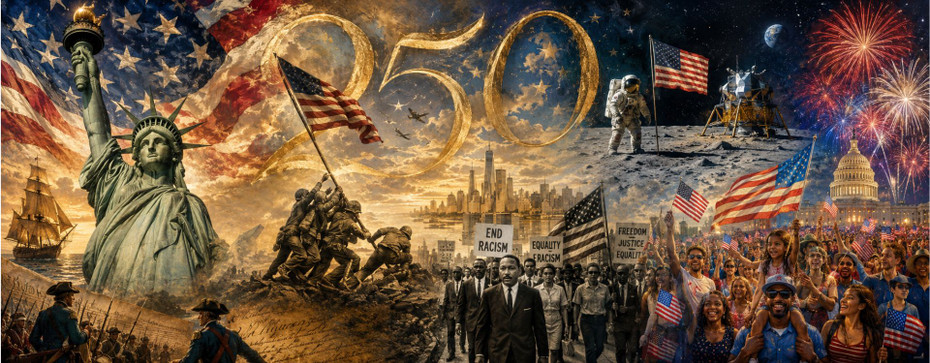
250 Years of Greatness: Why America Remains the Most Remarkable Experiment in Human History
There are countries with older histories. There are nations with more ancient cultures, longer dynasties, and centuries more of accumulated tradition. But there has never been — not once in the roughly 10,000 years of recorded human civilization — a country quite like the United States of America.
One Nation, 250 Years Strong: The Unapologetic Case for American Greatness
This July 4th marks 250 years since a group of farmers, lawyers, merchants, and visionaries put their names on a piece of parchment and told the most powerful empire on earth to go pound sand. And it worked.
So as we fire up the grills, pop the tops, set up the cornhole boards, and watch the fireworks paint the sky, let's take a moment to talk about something that doesn't get said enough in today's noise: America is genuinely, historically, remarkably great. Not perfect. Never perfect. But great — in ways that changed the world and continue to matter.
From a Wild Idea to the World's Beacon — The Founding That Changed Everything
In 1776, self-governance by common people wasn't just unusual — it was considered borderline insane by the political establishment of the world. Kings ruled. Bloodlines decided who held power. The idea that "all men are created equal" and that governments derive their authority from the consent of the governed was radical, dangerous, and frankly a little nuts.
And yet, it worked.
The framework the Founders built — a constitutional republic with separated powers, protected individual rights, and peaceful transfers of power — became the template that dozens of nations around the world eventually adopted or drew inspiration from. The U.S. Constitution is the oldest written national constitution still in operation in the world. Think about that. While empires rose and fell, while regimes were toppled and borders redrawn, this document has held.
The ideals embedded in that founding — freedom of speech, freedom of religion, freedom of the press, the right to a fair trial — weren't just American aspirations. They became the universal language of human rights that the entire modern world now speaks.
When the World Needed a Hero: America's Defining Role in World War II
By the late 1930s, the world was on fire. Nazi Germany had consumed much of Europe. Fascism was spreading. The Holocaust was underway. Britain was being bombed nightly. Japan had launched a campaign of conquest across the Pacific and Asia. The future of human freedom — not American freedom, human freedom — hung in genuine doubt.
The United States entered World War II on December 8, 1941, the day after Pearl Harbor. What followed was one of the most extraordinary mobilizations of human will and industrial power in history.
American factories that once made cars started making tanks and planes around the clock. Women entered the workforce en masse to keep it running. Sixteen million Americans put on uniforms. The economy — still recovering from the Great Depression — transformed into the "Arsenal of Democracy." By the peak of wartime production, the U.S. was building a ship every day and a plane every few hours.
The numbers are staggering. America produced 300,000 aircraft, 86,000 tanks, and 8.5 million rifles during the war. It provided over $50 billion in Lend-Lease aid to Allied nations — the equivalent of roughly $800 billion today — propping up Britain, the Soviet Union, and others who were fighting and bleeding before America officially joined.
Then American soldiers — farm boys from Iowa, steelworkers from Pittsburgh, immigrants' sons from Brooklyn — stormed the beaches of Normandy, island-hopped across the Pacific, and helped break the back of two of the most brutal military regimes the world had ever seen.
The liberation of Europe and the defeat of Imperial Japan didn't happen because of one country. It was a global effort. But without American industrial power, military sacrifice, and political will, the outcome is genuinely uncertain. The Holocaust may not have ended. Fascism may have consolidated. The 20th century — and everything that came after it — could have looked very, very different.
America showed up. And the world is better for it.
More Than a Country — The Innovations, Freedoms, and Values America Gave the World
Here's a just a small and partial list of things that came from the United States of America:
The airplane. The telephone. The internet. The polio vaccine. GPS. The personal computer. The iPhone. Rock and roll. Jazz. The Hollywood film industry. The moon landing.
American universities — MIT, Harvard, Stanford, Johns Hopkins — have produced more Nobel Prize winners than any other country's institutions. American medical research has led to treatments and cures that have saved hundreds of millions of lives globally.
The Marshall Plan, passed in 1948, sent over $13 billion (about $150 billion today) to rebuild war-devastated Europe — including the countries America had just finished defeating. Enemies became allies. Rubble became prosperity. It remains one of the most generous foreign policy acts in modern history.
America has been the world's largest donor to global humanitarian aid year after year. When there's a tsunami in Southeast Asia, an earthquake in Haiti, a famine in sub-Saharan Africa — American organizations, American dollars, and often American military logistics are among the first on the ground.
American culture — its music, movies, stories, and yes, its sports — has brought joy to billions of people in every corner of the globe. There's a kid in rural Japan wearing an NBA jersey. There's a family in Germany who hosts a Super Bowl party every year. There's a tailgate happening somewhere in the world tonight because they saw it in an American movie and thought, that looks like the best time possible.
Because it is.
Honest About Our Scars: Why America's Willingness to Reckon With the Past Makes It Stronger
America has done things it should not have done. The history of slavery — and the century of Jim Crow that followed — is a stain that cannot be minimized and should not be. The treatment of Native Americans. The long road toward equal rights for women (more than a few nations still consider women as 2nd class citizens)... for every group that had to fight to be included in the promise of "all men are created equal."
These are real. They are part of the American story.
But here is what is also true, and what is remarkable in the sweep of human history: America has tried, repeatedly and imperfectly, to correct itself.
The Civil War was fought and 360,000 Union soldiers died, in significant part, to end slavery. The 13th, 14th, and 15th Amendments rewrote the Constitution to include the people it had originally failed. The Civil Rights Act, the Voting Rights Act, the desegregation of the military, Brown v. Board of Education — these were not quiet adjustments. They were hard-won, fought-for transformations of a society trying to live up to its own ideals.
Most nations don't do that. Most nations in history swept their atrocities under the rug, denied them, or doubled down. America argues about its past loudly, publicly, and messily — and then, moves toward a more honest and just version of itself.
That process is ongoing. It's uncomfortable. It's supposed to be. A country that is genuinely committed to its founding ideals will always be in the uncomfortable work of trying to make them real for everyone. Like humans... countries aren't without flaws... nations aren't without warts. The USA isn't perfect but who or what is that is as complex and diverse as our large nation?
That's not weakness. That's integrity.
There is a reason why people risk life and limb to come here... and have for for hundreds of years.
250 and Still Going: The Spirit That Lives in Every Backyard, Ballgame, and Tailgate
Here's what 250 years actually looks like on the ground:
It looks like a neighborhood cookout where the family from El Salvador is teaching the family from Korea how to make tamales while the retired Marine next door mans the grill and argues about whether gas or charcoal is better. (It's charcoal. This is not up for debate.)
It looks like a kid who grew up with nothing building a business, or a first-generation college student graduating, or a veteran coming home to a welcome sign on the front door.
It looks like a couple million people gathering on the National Mall to watch fireworks over the monuments of a republic that has outlasted empires, depressions, world wars, assassinations, and culture wars — and is still standing.
It looks like a backyard tailgate with a cooler full of cold ones, a cornhole board set up in the grass, and a summer afternoon that doesn't ask anything of you except that you be present for it.
The American story is not a fairy tale. It never was. But it is one of the most audacious, improbable, and genuinely inspiring stories in human history — a story still being written by 330 million people who inherited both the ideals and the responsibility to keep reaching for them.
So this Fourth of July, raise a glass. Set up the boards. Watch the sky light up.
Two hundred and fifty years in, America is still worth celebrating.
Happy 250th Birthday, USA.
All American Tailgate is proud to be an American-made company crafting cornhole boards, bags, and tailgate gear right here in the good ol' U.S.A. From our family to yours — have a safe, fun, and unforgettable Fourth.